Definition
It was in 1971 that the name Silicon Valley was used for the first time.
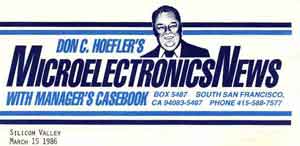
Journalist Don Hoefler used that term in a couple of articles in Electronic
News, a weekly industry tabloid, about the semiconductor-industry around
Palo Alto. Ralph Vaerst, then president of Ion Equipment suggested the
term to Hoefler.
Originally the term was used only to describe Santa Clara County but
later on the area, as Carolyn E. Tajnaj (1985) described it, "located on
the San Francisco, California, peninsula, radiates outward from Stanford
University. It is contained by the San Francisco Bay on the east, the Santa
Cruz Mountains on the west, and the Coast Range to the southeast."
Until the middle of this century, this agriculturally rich region of
Northern California was better know for its apricots and walnuts than for
its Apples (Rogers and Larsen, 1984). It was then known as the Valley of
Heart’s Delight.
In fact the basis of Silicon Valley started at Stanford University.
How it all started at Stanford
In order to understand what happened some knowledge of the history of
Stanford is needed.
Stanford University was founded in 1891 by Governor Leland Stanford
at his domain nearby 'El Palo Alto' (the high tree) in the memory of
his son Leland Stanford Junior. During its’ hundred years of existence
Stanford has become one of the best American Universities.
It was especially Prof. Frederick Terman, who was a Stanford graduate
himself, whose role was crucial for the development of the local high-tech
industry after and before World War II. In the twenties, administrators
at Stanford sought to improve the prestige of their institution by hiring
highly respected faculty members from East Coast universities. One of the
most important recruits those days turned out to be Professor of electrical
engineering Frederick Terman from the Massachusetts Institute of Technology
(MIT) who is now called "Father of Silicon Valley" by a lot of researchers.
He was concerned about the fact that a lot of his graduates went to the
East Coast because the lack of jobs in the Valley. To solve that problem
he started to encourage some of his students to start companies near the
university. Among these students were William Hewlett and David Packard.
The graduate student Hewlett had designed and built an audio oscillator
(1). Because Terman was convinced of the market potential he persuaded
Packard, who had moved to the East Coast to work for General Electric,
to return to Palo Alto and join Hewlett. Terman then stimulated them to
commercially produce their audio-oscillator. It was in 1937 that a small
company started in the famous garage in Palo Alto. Their audio-oscillator,
designed with Terman’s help, became the basis for a later deal with Walt
Disney Studios in 1939, for the film "Fantasia". That was the start of
an endless growth. In 1998 Hewlett Packard is a multinational, producing
computers, electronic measuring devices and equipment, with annual revenue
in 1997 of $42.9 billion and with 121,900 employees worldwide.
In the mean time some other students founded small companies who where
going to be the center of a local electronics-industry. During 1937, William
Hansen, Professor of Physics, teamed with Sigurd and Russell Varian to
develop the klystron tube, an electron tube in which bunching of electrons
is produced by electric fields and which is used for the generation and
amplification of ultra-high frequencies.
During the Second World War the brothers Sigurd and Russel Varian worked
rent free in a Stanford lab on their Klysttron tube. Later on radar and
Varian Associates (1948) inventions involving microwave radiation, evolved.
Stanford gave them, besides rent free lab use, $100 for supplies. In return,
Stanford was to share in any profits. The investment of Stanford was one
of the best ever because it brought in several millions dollar as royalties.
During World War II Prof. Terman made good contacts within Washington.
After his return to Stanford he succeeded in getting a lot of governmental
contracts for Stanford and local companies.
During the fifties a lot of, for that time revolutionary, new ways of
working as a University was introduced by Stanford. E.g.:
During the fifties money was needed in order to finance the rapid postwar
growth. These days the industrial park idea came up; Stanford was might
be poor financially seen but rich concerning the possession of land; about
over 3240 hectares of land was free. Then they faced one problem; the Founding
Grant by Leland Stanford prohibited the sale of his land. It didn’t take
them long to figure out there was nothing to prevent it from being leased.
And when that construction was investigated it turned out that long-term
leases were just as attractive to industry as out right ownership. The
Stanford Industrial Park, which was meant to be a "center of high technology
close to a cooperative university" as Tajnaj describes it (1985), was than
quickly founded (1951). Varian Associates was the first one to sign a lease
contract and soon after companies such as General Electric, Eastman Kodak
and many others followed.
During the fifties the defense programs in the field of air, space and
electronics strongly stimulated growth in Silicon Valley. Semiconductor
procurements by the defense agencies amounted to approximately two-fifths
of total production. Lockheed Aerospace Co. located itself in 1956 in "Stanford
Industrial park" and a year later in Sunnyvale. Lockheed is a good example
of how Stanford succeeded in developing good relationships with companies.
Lockheed helped starting up a space and air department at the university
and Stanford gave scientific advises and training for their employees in
return. Soon after the arrival of Lockheed other research departments went
to the region like IBM (1952), NASA (1958), Xerox (1970).
The formation of the biology and chemistry business
After Terman became vice president of Stanford in 1958 he recruited
Carl Djerassi, a University of Wisconsin graduate, who had become vice
president for research at Mexico-based Syntex Corporation. This set in
motion a whole new chain of company formation in biology and medicine.
The University’s Chemistry Department became one of the best in the USA.
Djerassi managed to get Syntex to establish a US subsidiary and research
branch in
the Stanford Industrial Park. Besides that he even got Syntex's executive
vice president, Alejandro Zaffaroni, transferred to the new location. Syntex
became an international company with headquarters in the Stanford Research
Park.
Together Djerassi and Zaffaroni were the men behind the formation of
three new companies, respectively Synvar, Zoecon, and ALZA.
In 1963 Synvar Associates was founded. It was started as a joint venture
of Varian Associates and Syntex.
Syntex decided in 1968 to put all of their patents, know-how, and key
research personnel from their insect research into a separate company,
in which Syntex would retain 49 percent ownership. The remaining 51 percent
would be spun off to Syntex stockholders as stock-rights offering. That
way Zoecon was founded as the first company dedicated solely to the development
of new approaches to insect control.
That same year, Zaffaroni left Syntex to form his own company, ALZA.
This company developed new methods of drug delivery.
These companies were at the start of Silicon Valley a home for the biology
and chemistry business, although it’s a minority when compared to the other
businesses.
How the silicon came into the valley
In 1955 Stanford graduate student Dr.William Shockley founded Shockley
Transistor, together with some talented young scholars from the East Coast.
He had developed a transistor at the Bell Laboratory based on the principle
of amplifying an electrical current using a solid semiconducting material.
The concept was based on the fact that it is possible to selectively control
the flow of electricity through silicon, designating some areas as current
conductors and adjacent areas as insulators. This principle gives
meaning to, the term "semiconductor". A suitable alternative for the
commercially unreliable vacuum tube (2). Tubes carried out the essential
task of voice amplification,
electromechanical circuit switching and other functions involving the
regulated conduction of electrical current. The resultant discoveries combined
to form the basic
concept behind the transistor, the compact electrical "transfer resistor"
that was to power the coming High Tech Revolution.
An internal dispute arose over the choice between the two semiconducting
materials silicon and germanium. Shockley had a strong preference for germanium.
But engineers Gordon Moore, C. Sheldon Roberts, Eugene Kleiner, Victor
Grinich, Julius Blank, Jean Hoerni and Jay Last, chose silicon as the more
appropriate semiconducting material, which in turn, led them to leave Shockley
in 1957.
Robert Noyce, who had worked for a short time for Shockley as well,
joined the seven engineers, and in 1958 they founded Fairchild Semiconductor
in Mountain View with backing from Fairchild Camera and instrument in Long
Island, NY.
Fairchild became the first company to successfully mass manufacture
a micro-sized device capable of integrating large numbers of electrical
"on-off" switching functions, stored in simple memory cells, all etched
onto a silicon chip. Nowadays better known as the integrated circuit. This
company was the first one to manufacture exclusively in silicon and rapidly
developed into one of the largest firms in the California electronics industry.
Besides that the company was on the basis for a lot of spin-offs and
startups such as Intel, Signetics (now Philips Semiconductors), National
Semiconductors and AMD. These companies were on the basis of the semiconductor-industry
what led later to the name Silicon Valley.
Shockley Transistor Corporation never recovered from the blow of the
Fairchild spin-off (Rogers & Larsen) and was sold to Clevite in 1960,
to ITT in 1965, then closed for good in 1968, (Lowood).
In the sixties the focus was on small series of customized chips but
the disadvantage were of course the high costs. Therefore a new business
area was developed in the seventies based on standardization and economies
of scale with especially memory (DRAM) chips.
Gordon Moore and Robert Noyce left Fairchild after 10 years and with
the help of the venture capitalist, Arthur Rock, started a company they
named Intel ( contraction of "integrated electronics"). Early on, the company
focussed on a quest to continually maximize the amount of circuits that
could be put on a piece of silicon. It was in 1970 that Intel introduced
the 1 k DRAM chip on the market, in 1974 the 4 K DRAMs. In 1979 sixteen
companies (of whom five were Japanese) were competing to produce the 16
k DRAMS as cheap as possible. The integrated circuit semiconductor "chips"
of Intel soon became the standard for the industry.
In the seventies the microprocessor industry also changed when Intel
introduced the standard CPU (computer processing unit or microprocessor)
8088 in 1973. Unique about these CPU’s was that they could perform the
millions, then billions, of humble "on-off" switches that together form
the basis of a computer's operation. From that moment on the random access
memory chip density has doubled every two years. This invention was on
the basis of a lot of important inventions that shaped the late 20th
Century.
But in 1975 there were a lot of other companies producing the same chip
much cheaper. The price of an 8088 chip went from $110 in 1975 to $20 in
1977 and $8 in 1980. This was because of standardization and economies
of scale (the more one produces the cheaper it becomes).
The change to a system of mass production was being seen by the semiconductor
industry in Silicon Valley as a logic phase in the maturity process of
their industry. They didn’t recognize the unique advantages of Silicon
Valley and used the traditional, autarkic organisationmodels for mass production.
They didn’t care a lot about customers and separated design and development
departments of the production. The consequences in the market for memorychips
were dramatic: in 1986 it was dominated by Japanese companies, which were
able, thanks to continuing improvements in the productionprocess and good
relations with suppliers and customers, to produce cheaper. The semiconductor
industry seemed to be heading the same way as the car- and steel industry.
Especially production facilities were transferred to cheap-labor countries.
The PC revolution
Meanwhile in March 1975 some students studying technology related subjects
(techies) formed the Homebrew Computer Club in Menlo Park to experiment
with building home computers.
One of the founding members was Steve Wozniak. Fully convinced of the
fact that he could do better than the others he build his first homecomputer
with a cheap microprocessor bought at a computer show and built a machine
around it himself. At the meetings of the Homebrew Computer Club he showed
it to the other members and handed out copies of his design.
After his friend Steve Jobs joined him they started Apple Computer together
in 1976 in Jobs’ garage in Cupertino. On April 1, 1976, they released the
Apple I. In order to establish growth they needed some support. That support
came in the person of Mike Markkula who was an Intel marketeer. Impressed
by the Apple, Markula persuaded them to make a business plan, arranged
financing, invested his own money and stayed with the new company. Apple
did not begin to take off until 1977. That year they introduced the Apple
II at a local computer trade show. That was the beginning of a successful
multinational.
But in 1982 International Business Corporation (IBM) entered the personal
computer market. With the power of "Big Blue" the PC quickly began to dominate
the playing field. The IBM PC had a disk operating system (DOS developed
by Microsoft) that became an industry standard. Hewlett Packard had launched
its first PC in 1980. Steadily improving microprocessors triggered a related
explosion of other peripherals: printers, modems, disk drives, interlinked
networks, equipment for building chips, video games, computer-assisted
design. The early eighties were that way dominated by microcomputer expansions.
From Silicon Valley towards Internet Valley ?
As I described in paragraph 1.5 American firms had controlled the semiconductor
memory market throughout the 1970’s though 1984 brought a startling reversal
as Japanese producers moved into an early lead and went on to capture all
of the 256K DRAM market, thus dominating the latest development. Besides
that, at the end of the eighties and the beginning of the nineties Silicon
Valley suffered a crisis because of the first effects of competition of
other states such as Texas (Austin). Besides that big high-tech companies
started to restructure and the expenses of the US government were drastically
lowered.
In 1981 a company was founded that would later be one of the leaders
of a new industry that would help Silicon Valley to overcome the problems
experienced in the semiconductor market.
In 1981 Stanford graduate student Andreas got tired of the fact that
he had to go to the campus computer center whenever he needed a powerful
system. Bechtolsheim was inspired by what he had seen at Xerox’s fabled
Palo Alto Research Center. In that center they had worked out the concept
of easy-to-use, networked desktop computers. Based upon that inspiration
he envisioned an "open" system that would run on the operating system UNIX.
UNIX is a popular operating system among engineers and scientists and was
designed at AT&T’s Bell Labs. While he was building prototypes of his
own money Stanford graduate Vinod Khosla was attracted by the strong demand
for the system. He convinced Bechtolsheim to join him in building a company.
Together they recruited Scott McNealy, also a Stanford graduate, to take
care of manufacturing. Bill Joy, principal architect and designer for UC
Berkeley’s version of UNIX, joined them for the company’s software efforts.
They called the company Sun, which is an acronym for Stanford University
Network (Sunet), the communications project for which Bechtolsheim designed
his workstation. Three months after its foundation the first products were
shipped.
Sun was (almost) the only player in the market to champion open systems,
designing and licensing NFS file sharing software that soon became the
industry standard.
In 1984 another company was founded that would also become a major player
in the open systems market. The couple Leonard Bosack and Sandra Lerner
then founded Cisco Systems. Bosack was Director of Computer Facilities
for Stanford’s Department of Computer Science and Lerner was Director of
Computer Facilities for Stanford’s Graduate School of Business. On the
basis of the company was the technology that was developed at Stanford
in the late seventies to support the campus-wide network Sunet and to integrate
a multiplicity of local networks into a single integrated whole (3). The
first products were shipped by Cisco in March 1986.
In the middle of the eighties, the market had begun to embrace the open
systems concept. While competitors hedged and hawed, Sun and Cisco continued
to make rapid gains in important technical market segments. That way they
were ahead of most of their competitors when the Internet set the standard
for open networks and the market started "booming".
Although the Internet became "hot" in the beginning of the nineties
thanks to the development of the browser, the basis of the Internet is
in 1964. That year RAND (an acronym for research and development), a governmental
research and development institute started as a Cold War think-tank, found
a solution to cope with the strategic problem of how the US authorities
should successfully communicate after a nuclear war. RAND staffer Paul
Baran made a proposal for a network that would have no central authority
and it would be designed in such a way that it could operate while in tatters.
RAND started, together with the Massachusetts Institute of Technology
and the University of California at Los Angeles, to work on this revolutionary
concept of a decentralized, blastproof, packet-switching network based
on UNIX. During the years more and more institutions came involved. In
1969 the first node was installed in UCLA. By the end of December 1969
there were four nodes on the infant network that was named ARPANET after
its Pentagon sponsor (Advanced Research Projects Agency). Then it started
to grow rapidly. By 1972 ARPANET had thirty-seven nodes and throughout
the seventies it kept growing.
The original standard for communication was known as Network Control
Protocol (NCP) but was later on superceded by a higher-level, more sophisticated
standard known as TCP/IP (4). Since the TCP/ IP protocol was public domain
other networks started to use it and linked to ARPANET. Because of its
decentralized structure expansion was easy. That way the number of linked
networks that became part of the network, which came to be known as the
"Internet" (acronym of International network), increased rapidly.
Nowadays most people think of the World Wide Web when they think of
the Internet. But the World Wide Web is actually one of the most recent
developments. The ideas behind the World Wide Web (WWW) were formulated
at Centre Europeenne pour la Recherche Nucleair (CERN), Switzerland.In
November 1990 a propoasal was submitted by Tim Berners-Lee and Robert Cailliau
for a truly visionary idea; a "universal hypertext system" (5).
The World Wide Web extends the well established concept of hypertext
by making it possible for the destination document to be located on a completely
different computer from the source document, either one located anywhere
on the network. This is made possible by the so-called client-server architecture.
A user who wants to access information runs a World Wide Web client (browser)
on their local computer. The client fetches documents from remote network
nodes by connecting to a server on that node and requesting the document
to be retrieved. A document typically can be requested and fetched in less
than a second, not depending on the distance between the requester and
location.
The first browsers were available to a limited number of users because
they could only be used on specific platforms. Then CERN developed a linemode
browser which could run on many platforms but which displayed its output
only on character-based terminals. These early browsers were followed by
the first browsers designed for X-Windows.
Initially the growth of the World Wide Web was relatively slow. By the
end of 1992 there were about 50 hypertext transfer protocol (HTTP) servers.
At about the same time, Gopher, a somewhat similar information retrieval
tool as WWW but based on menus and plain text documents rather than hypertext,
was expanding rapidly with several hundred servers.
In 1993 this situation was drastically changed by the development of
the Mosaic client by a team of students at the National Center for Supercomputer
Applications (NCSA) at the University of Illinois in Champaign-Urbana.
The Mosaic client (6) for World Wide Web was originally developed for X-Windows
under Unix, with subsequent versions released for both the Macintosh and
PC platforms.
Silicon Graphics founder and former Stanford Professor Jim Clark hired
one of the main authors of Mosaic, Mark Andreesen, away from the NCSA.
Whereas most people perceived the Internet as academic, noncommercial and
impractical Clark believed strongly in the coming convergence of digital
data, audio, and video on the Internet. Together with Andreesen they founded
a company called Mosaic communications and soon after they changed the
name to Netscape Communications Corporation.
During 1993 the usage of WWW began to grow exponentially and up till
now it is still doing so.
For a lot of companies the Internet, especially the WWW changed the
Information Communication Technology (ICT) world. For the software industry
for example that meant a change from ‘client/server’ to ‘web applications’
whereas the content is dynamic built up from different place on the World
Wide Web and depending on the user.
As far as Silicon Valley was concerned it survived a new revolution
and again important companies had emerged from the whole revolution; Sun,
Cisco and Netscape. Nowadays more than 80 percent of Internet base technology
comes from Cisco and about the half of the people surfing the WWW use Netscape’s
browserprogram Navigator. SUN had an annual revenue of 8.5 billion in 1997
and thousands of employees worldwide.
Notes
1. An electronic device that generates electrical signals in the
frequency range of human hearing. It produces a clear tone when connected
to a loud speaker.
2. The first electronic computing device was created in 1946 at
the University of Pennsylvania. That year the Sperry-Rand Company developed
an enormous calculating machine that was called the Electronic Numerical
Integrator and Computer (ENIAC). This machine depended upon more than 18,000
vacuum tubes to perform the basic function of electromechanical switching
ferrite memory cores. The principle behind this machine was that each core
when switched to either the on or off position, represented a yes or no
answer, one bit of information, to a computational question. Linking similarly
posed yes or no questions, known today as "binary code" (0’s and 1’s),
it was then possible to perform highly complex calculations. The problem
was that even though this was a significant breakthrough, it was also tremendously
impractical. The tubes, gave off an incredible amount of heat and were
constantly subject to overload and burnout.
3. The most important part of their router is its operating software.
Cisco’s software is called IOS (Internetwork Operating System). IOS software
is scalable to best meet individual needs. In addition to choice router
hardware (performance and interfaces) Cisco users, unlike users of other
manufacturer’s products, can select from various software sets offering
different performance features. This approach allows the user to select
the most appropriate combination of protocols, thereby avoiding additional
costs incurred by features not needed.
4. Transmission Control Protocol (TCP) converts messages
into streams of packets at the source, then reassembles them back into
messages at the destination. Internet Protocol handles the addressing,
seeing to it that packets are routed across multiple nodes and even across
multiple networks with multiple standards.
5. The WWW is designed around two key concepts: hypertext
documents and network based information retrieval. Hypertext documents
are simple documents in which words or phrases act as links to other documents.
Typically hypertexts documents are presented to the user with text that
can act ass a link highlighted in some way, and the user is able to access
the linked documents by clicking with a mouse on highlighted areas.
6. The Mosaic client software added a few new key
features to the World Wide Web: the ability to display embedded images
within documents, enabling authors to greatly enhance the aesthetics of
their documents; the ability to incorporate links to simple multimedia
items such as short movie and sound clips; and the ability to display forms.
Forms greatly enhanced the original search mechanism built into WWW by
allowing documents to contain fields that the user could fill in, or select
from a list of choices, before clicking on a link to request further information.
The introduction of forms to the WWW opened a new arena of application
in which the World Wide Web acts not only as way of viewing static documents,
but also as a way of interacting with the information in a simple but flexible
manner, enabling the design of web-based graphical interface to databases
and similar applications.
Bibliography:
* Jelle Bouma; "Internet en Intranet, Profiel, 1997.
Copyright Alexander Loudon 1998
The first two will be more deeply discussed in the coming chapters.
From specialized High-Tech to mass-production
* Jim McCormick; "A brief history of Silicon Valley", http://www.silvalonline.com/silhist.html,
1995.
* P. Freiberger and M. Swaine; " Fire in the Valley: The Making of
the Personal Computer", Osborne/McGraw-Hill, 1984.
* Gregory Gromov; "Silicon Valley to Internet Valley" ,http://www.internetvalley.com/fintrd22.htm,
Internetvalley Inc. 1998.
* Gregory Gromov; "Silicon Valley History", http://www.internetvalley.com/frame-right-svhistory-1.html,
Internetvalley Inc. 1998.
* Don C. Hoefler; "Silicon Valley USA" in Electronic News, 1971.
* David Jacobson; "Founding Fathers", Stanford Magazine, July/August
1998.
* Tony Johnson; "Spinning the World Wide Web", in SLAC Beamline, Fall
1994.
* Joint Venture: Silicon Valley Network; Diverse publications
* Dan M. Khanna; "The Rise, Decline, And Renewal of Silicon Valley's
High Technology Industry", 1997 .
* Henry Lowood; "From Steeples of Excellence to Silicon Valley, Stanford
University Libraries, 1987.
* Henry Lowood; "The story of Varian Associates and Stanford Industrial
Park", Stanford University Libraries, 1987.
* Paul Mackun; "Silicon Valley and Route 128’ Two faces of the American
Technopolis", University of California at Berkeley
* Rogers, E.M. and J.K. Larsen; "Silicon Valley Fever" Basic Books,
1984.
* Santa Clara Valley Historical Association; "The making of Silicon
Valley; a hundred year renaissance", 1995.
* Annalee Saxenian; "Regional Advantage. Culture and Competition in
Silicon Valley and Route 128", Harvard 1994.
* Huub Schuurmans; "Silicon Valley: Veel geimiteerd, ongeevenaard",
TechNieuws, August 97, Dutch Ministry of Economic Affairs.
* Ben Segal; "A short history of Internet protocols at CERN", CERN,
April 1995.
* Carolyn Tajnaj; Links Between Stanford University and Industry, Stanford
University.
* Carolyn Tajnaj; "Fred Terman, the Father of Silicon Valley," IEEE
Design & Test of Computers, April 1985, 2, 2.
* Carolyn Tajnaj; "From the Valley of Heart’s Delight to the Silicon
Valley: A Study of Stanford University’s Role in the Transformation", Stanford
1996.
* http://www.rand.org
* http://www.internic.net